.webp)
Financial institutions are facing steeper fines for failing to prevent money laundering — even though verifying customer transactions has been mandatory under the Wwft (the Dutch Money Laundering and Terrorist Financing Prevention Act) since 2007.
One quick flag before the rewrite: this piece names a specific company (Robeco) and a specific €2 million fine, with a detailed account of the underlying customer transaction. Even if this was public news at the time, using a named real company's regulatory penalty as a central example in your own marketing content carries real reputational and potentially legal risk — especially content that's being revived years later. I'd strongly recommend either confirming this is still appropriate to publish (checking with legal/compliance) or replacing it with an anonymized or hypothetical example ("a European asset manager was recently fined €2 million...") that makes the same point without naming a specific institution. I've kept the Robeco framing below only so you can see the fix in context — I wouldn't publish it as-is.
The cost of getting this wrong
A recent example: a financial institution was fined €2 million for failing to adequately implement anti-money-laundering procedures. A customer deposited €100,000 and left it untouched for years — no red flags raised — then transferred the full amount, plus interest, to a recently registered private account belonging to a third party.
Verification of Payee closes exactly this kind of gap. It confirms who holds an account before money moves, so a bank always knows the account holder's identity and can't unknowingly send funds to an unverified third party.
The scale of the problem
This isn't an isolated case. An estimated €16 billion in criminal proceeds — from drug trafficking, fraud, and similar crimes — moves through the Netherlands' financial system every year. Criminals are constantly finding new ways to hide where that money came from: moving it through countries with weaker anti-money-laundering rules, or funneling it through shell companies designed to make it look legitimate.
KYC: a shared responsibility
Fighting money laundering takes a coordinated effort across financial regulators, banks, insurers, notaries, and accountants. Under the "Know Your Customer" (KYC) principle, banks are responsible for scrutinizing their customers' transactions, while regulators supervise whether they're doing it well enough.
Raising the bar
The Dutch government has spent over €634 million since 2010 pursuing money launderers, recovering more than €740 million in illicit funds. That's a meaningful result — but it still falls short of what's needed, which means current monitoring approaches have to get sharper and better coordinated.
Smarter tools can help close that gap, both by clearing legacy cases faster and by giving new customers faster, safer access to the financial system.
Banks are taking this seriously
Major Dutch banks are stepping up their own efforts. In 2021, ABN Amro, ING, Rabobank, and de Volksbank closed nearly 45,000 customer accounts combined — 7,700 of them specifically due to money-laundering or terrorism-financing risk. Rabobank alone is investing a quarter of a billion euros to strengthen its money-laundering controls.
How Verification of Payee supports Wwft compliance
Current controls clearly aren't catching enough. Insurers, investment platforms, pension funds, and other regulated institutions need a sharper, more efficient approach.
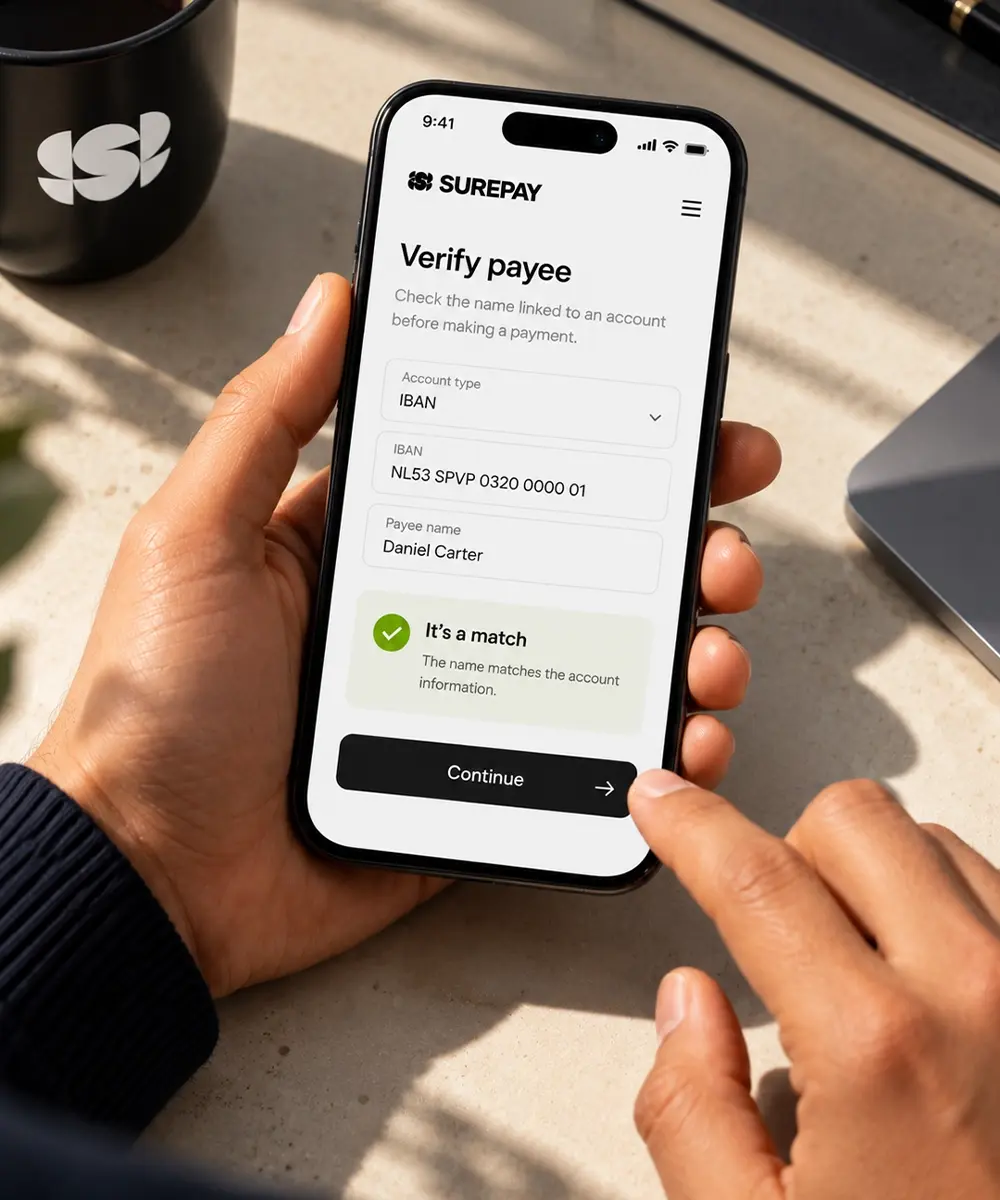
Under the Wwft, regulated companies must verify a new customer's identity and scrutinize the flow of their money. SurePay's Verification of Payee does exactly this: it matches a customer's name to their IBAN through a direct connection with their bank, giving you real assurance about both who the customer is and which account they're actually using.
From there, a financial institution can run that verified identity against PEP or sanctions list databases to determine whether the customer should be allowed access to the financial system at all.
Ready to strengthen your Wwft compliance? Learn more about Account Verification or schedule a meeting to see how it works.